
Issue 23
This week, Denise and I were sent a question about a specific project which has us thinking about a more-general question that should be on the minds of real estate agents far and wide.
As more types of middle housing are built, how is that going to impact appreciation rates for smaller housing product in the future?
We are actually already seeing the impact of this in Seattle. Let's think back 20+ years ago, before we had a surge of townhomes. At the time, if one wanted to buy a smaller type of unit, they could generally choose from either 1) a condo in a building 2) an older and smaller 2-bedroom bungalow on a full-size lot or 3) a multi-level townhome on a small lot.
We have seen a surge of townhomes built since then, providing more supply for option #3. How has this increasing supply of townhomes impacted both residential and townhome sales? Let's dive into the data!
NUMBER OF ACTIVE LISTINGS
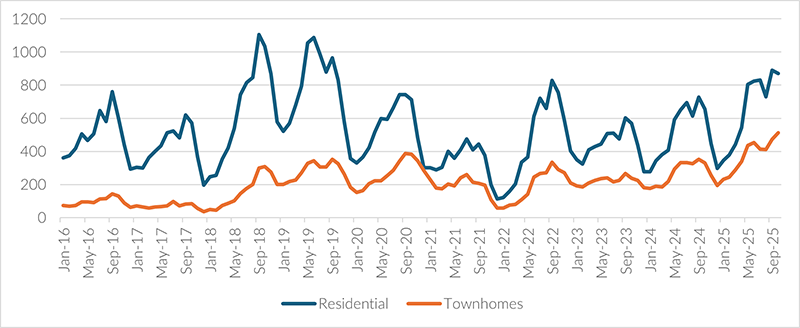
In NWMLS, I pulled active listings for style codes 10-18 (residential) and then for style code 32 (townhouse). Going back 10 years to January of 2016, we can see how the number of townhomes for sale has increased over the years. The gap between residential and townhomes is shrinking, mainly due to the supply of townhomes increasing. This is due to both just the sheer numbers of each product but it is also representative of homes that may take longer to sell and are represented over multiple periods.
MEDIAN SALES PRICES
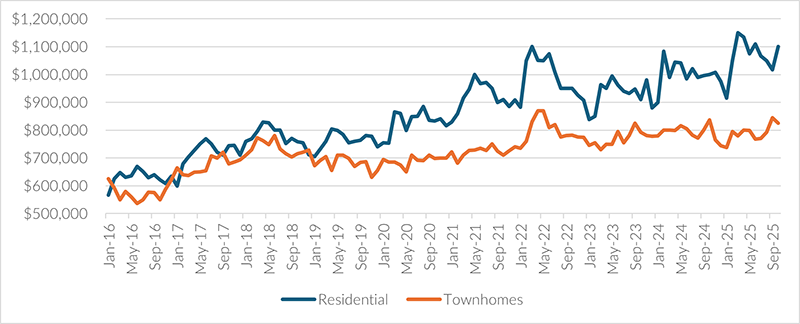
If our supply of townhomes is increasing, what is that doing to median sales prices? This graph is very telling! We see the median sales prices for both residential and townhomes increasing, but residential median sales prices are increasing at a faster rate than townhomes. In fact, the gap is continuing to widen.
Condos were not included in this analysis, ironically, due to middle housing. It used to be the majority of condos were in buildings. However, with more and more people condoizing a single family lot into multiple ADU units, we don't have an apples-to-apples way to compare these. However, if you look at the graph below, it is interesting to see that the condo pricing trend more-closely mirrors the townhouse trend and not the residential trend.
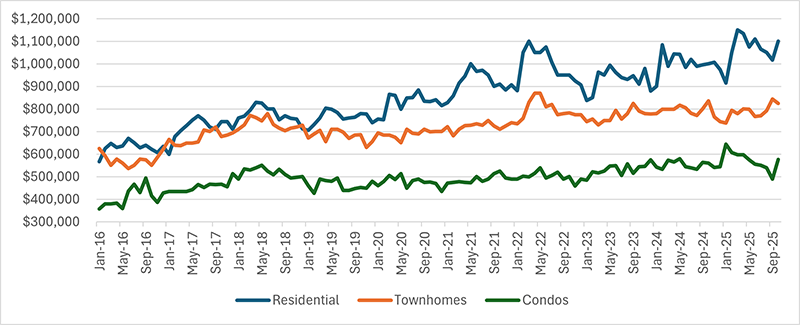
Information derived from NWMLS
GREATER SUPPLY WITH UNCHANGING DEMAND WILL IMPACT PRICING
If Seattle's (just the city of Seattle) goal is to create 112,000 new housing units by 2044, it is expected that many of these will be either large multi-family (apartments and condos), small multi-family (condos, townhomes, or condoized multi-family), or ADUs (for rent or condoized for sale).
In fact, if we look at 2024 city of Seattle building data (which was a record-setting year, by the way), "builders had opened 12,730 housing units through October — by far the most finished during a calendar year, even though it reflects only 10 months of activity. The next highest year for housing construction was the Amazon boom year 2019, with 10,937 units."
What was the makeup of what actually got built? Looking at the City of Seattle building dashboard, we can get a full picture of what became available in 2024 (both for rent and for sale):
- 867 were ADUs or cottages
- 9700 were multifamily or mixed use apartments
- 136 were assisted living or other
- 879 were rowhouses or townhouses
- 302 detached single family homes - only 2.5% of all the units built!
https://seattlecitygis.maps.arcgis.com/apps/dashboards/1111d274c85e4ca48af719da4b26fe9f
There are a few takeaways from this:
The number of detached residential fee simple units will decrease in urban areas where there is limited infill potential. As older homes are demolished to make way for denser housing, this will likely impact the total number of detached homes available, possibly driving up demand and prices.
Then we have a number of smaller types of units, that are increasing in number, that will be vying for the same pricing buyer pool:
- Condoized detached ADUs and cottages
- Condoized attached multi-family units (2-6 units)
- Condos (traditional condos in a building)
- Townhomes
Next week, we are going to be diving into what buyers will weigh when looking at these different types of units - this will be helpful for you as are helping buyers in this category and sellers of these types of properties.
But in the meantime, the takeaway is that with more of the smaller type of product coming on the market, we should see slower price growth for that type of product due to the amount of supply.
Remember, the goal is to increase housing supply in order to create a healthier supply of housing for our growing population. We are achieving this goal!





Responses