
Issue 26
I apologize for not having a newsletter done for you in a couple of weeks. I was going to be writing about modular, manufactured, and tiny homes as well as modular components. You will need to tune in next week for that! In the meantime, I am going to share about what I was doing the week before last as it is a tale to help buyers looking at buying in small HOAs and with private road maintenance agreements do their due diligence and create good plans.
Over the last few weeks as the northwest corner of Washington State was experiencing catastrophic flooding, my vacation rental property mountain community in Eastern Washington was experiencing an unprecedented event as well. It started on Thursday, December 11th during ENCORE. Western Washington was getting deluged by an atmospheric river which included inches of warm rain. In Mazama, we already had snow on the ground, so a warm rain, and a lot of it, was not what we needed.
In 2021, six weeks after we closed on this house, the Cedar Creek Fire ripped through the forest area above our house (Lucky Jim and Sandy Butte bluffs extend up more than 2000 feet behind the community, most of the upper area burned). This is Forest Service and Department of Natural Resources land which our properties border. In a burn scar, trees and vegetation are destroyed which causes erosion. Depending on how the fire burns, the dirt can also turn glass-like which means it is less likely to absorb the way it did before.
A seasonal creek meanders down the bluff and percolates into the ground behind our community. There are many seasonal creeks in this valley that, prior to the fire, were not a challenge to maintain from year to year (though flow varies from year to year). Starting two springs ago, however, we did have a few days in which the snow runoff was more than our seasonal creek could handle, but this simply caused some silt buildup in a corner of our community – no properties were threatened. We got sandbags from Okanogan County Emergency Management and the problem was mostly contained.
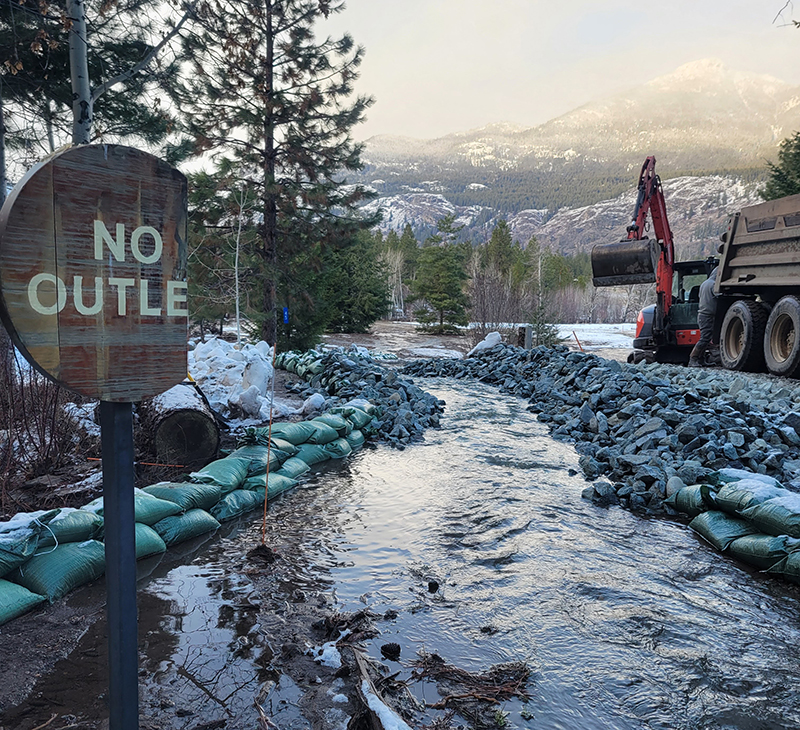
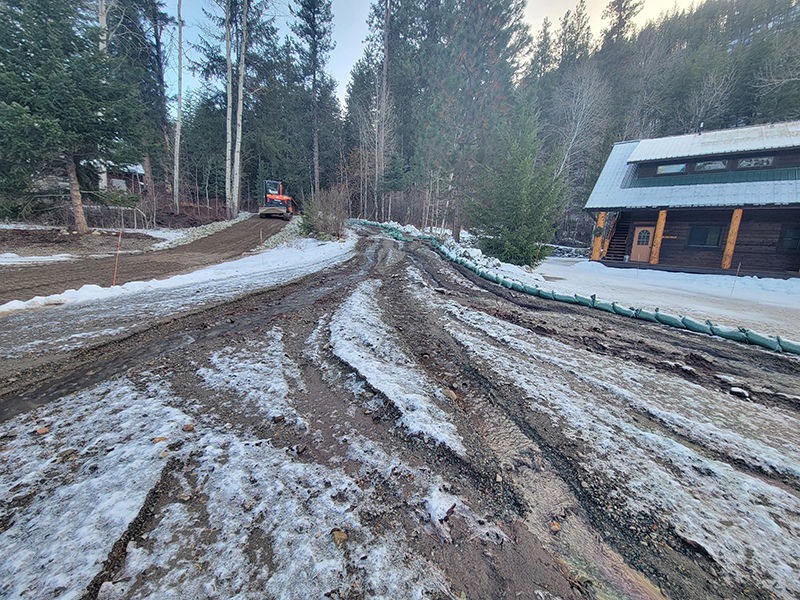
Fast-forward to December 11th. The seasonal creek, faced with flow that was probably 5-6 times what we would normally expect, came charging down the hill, carrying dirt, rocks, and other debris with it, and cut a new channel between two houses (one of which is ours – the other is a newly-completed home whose garage foundation is facing direct impact from this new creek), under a transformer, into our main community road, over a culvert, through a field, and drained into an irrigation ditch approximately 300 yards from where it entered the community.
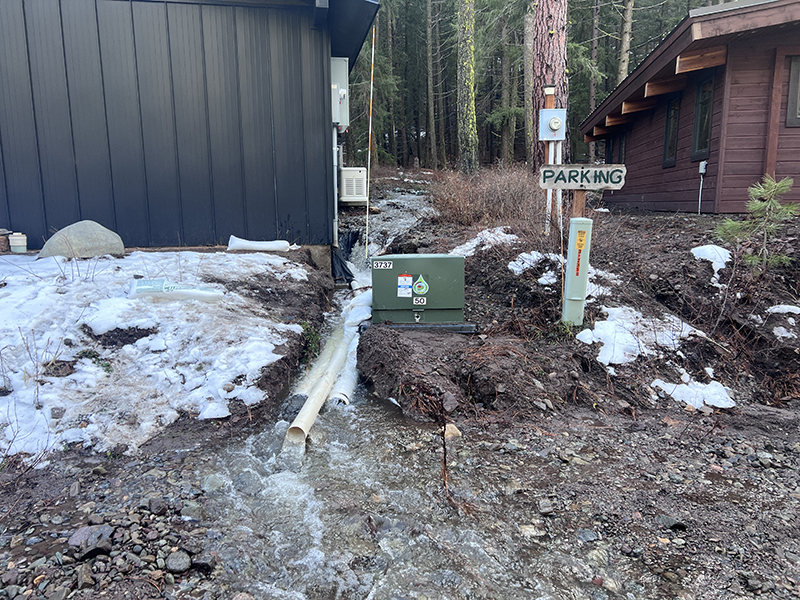
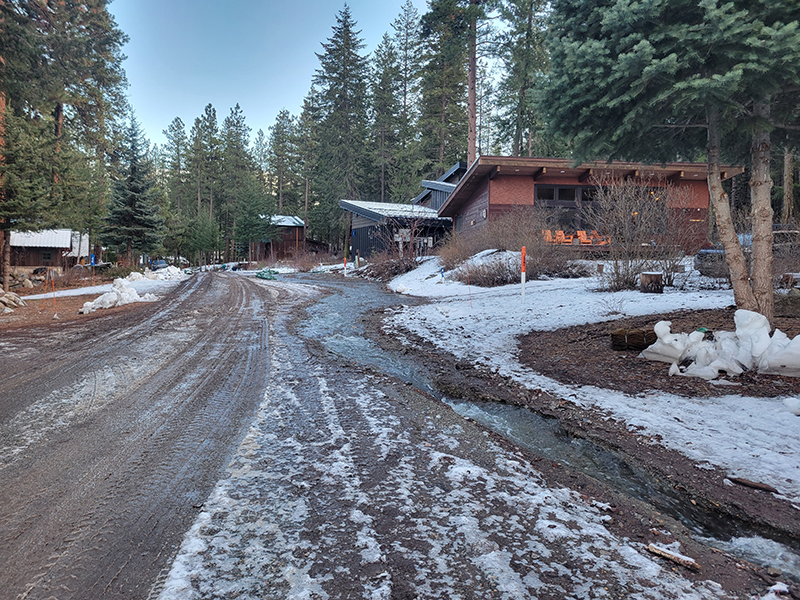
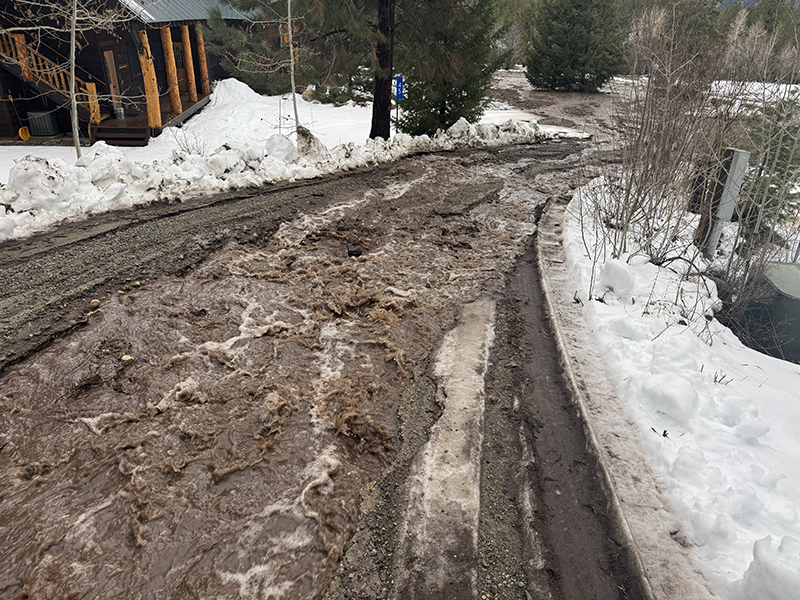
This new creek and channel is a challenge and it is not one our HOA can solve. We can’t put the creek back because engineering and excavation would need to occur on Forest Service land. Further, last spring, the creek could not hold the volume of water that was coming off the bluff. Anything we do to divert it could cause someone else’s property to be impacted. This requires specialists and a whole-valley stormwater mitigation plan, which we don’t currently have but are now working on with entities such as Emergency Management, DNR, the Forest Service, the Department of Transportation, the Army Corps of Engineers, and the communities up and down the valley that are impacted. The plan now is to let the creek flow as Mother Nature directed and rework our road system around that.
In this case, we had five days to formulate a plan. On Wednesday, December 17th, it was expected to plummet to freezing and drop a foot of snow. Any road repair to make our road system functional again had to occur in that window or our community would not be able to be snowplowed through the winter. Our roads were covered in silt and debris which needed to be removed, new aggregate needed to be installed and packed down, and we needed to figure out another path over the culvert since the creek made that section of road impassable.
I really wish I could share how agonizing these few days were. We probably created and installed 250 sandbags to contain the new creek in its banks so it would not do further damage (my sandbagging skills are on point!), we kept working on solutions for the culvert bridge with our contractor, but nothing seemed to be working as the creek now dominated that road. Tuesday at noon, when it was clear our latest two solutions weren’t going to work (putting down 4-6” aggregate on top of the water and letting it flow around – there was just too much water to make that work and our second solution, to quickly improve a secondary rural road that provided summer access to the property, but too much of it was under water and saturated to make that work) that was a dark moment. We had less than 24 hours to come up with and install a viable solution.
It is amazing what 20 minutes in a warm house and a fresh cup of coffee can do. In the recesses of my brain, I remembered that it was mentioned that there was a space piece of culvert laying around somewhere. If we could lay it next to the existing culvert and put our new large rock over it, we could build a new bridge next to the one the creek had taken over. The culvert was located (four of us fishing it out of a field and rolling it to the bridge was something to behold – it turned out to be too small, but our neighbor had just the right diameter and we had it on our property in about 20 minutes). Our contractor thought this was an excellent solution. We got it done right on time! Check it out:
At this point, you might be thinking, “OK, but how does a mountain community flooding problem relate to middle housing, most of which is urban?”
Great question – this is where we need to turn our attention to HOAs and private road agreements.
In our case in Mazama, the roads are commonly owned and maintained by the HOA. This means that no city, county, or the Department of Transportation was going to be responsible for rebuilding the damaged section of our road. We had recently completed a Reserve Study as required by Washington State and had listed our roads as something we would be maintaining on an annual basis, but we didn’t foresee needing to make a major investment in this asset. Also, flooding and landslides are not covered by typical insurance policies. So who is on the hook for these expenses? – the HOA and its members.
Now let’s imagine an urban setting – perhaps even in recently-flooded Burlington, Washington in which there is a primary residence with two ADUs that have been condoized. Floodwaters rise and for the purposes of this example, let’s assume the houses do not flood, each homeowner has flood insurance, but the floodwaters create a deep chasm in the common driveway that exposes the sewer line.
The questions at this point are...does the HOA have flood insurance? and where does the homeowner’s flood insurance end and the homeowner’s begin?
It very well may be that common spaces are not covered – such as pathways, driveways, and shared infrastructure including water and sewer pipes that service the property fall into this gray area. Does the HOA have the necessary funds in reserve to deal with a catastrophic event like this? OR, is the buyer prepared to foot their share of the bill? These are questions your buyers should be asking before buying and pouring over HOA documents to find out - perhaps even getting legal advice.
Another scenario to educate your buyers about are private roads, which is currently a challenge in other neighborhoods in Mazama without HOAs. As we are getting more creative with land use to solve our housing crisis, we expect to see more private roads formed. For example, in Bellingham, we have large, deep lots in certain areas. As lots are either subdivided or developed, private roads from the city-maintained street to the back of the property may be formed. Any buyer who is thinking about purchasing a property with a private road should be reviewing the road maintenance agreement diligently for all the “what ifs”: What if emergency repairs are needed? How many homeowners need to approve expenses? What happens if a property owner isn’t paying?
This last question is key – if the agreement is vague and doesn’t outline how monies are accounted for or due from each property owner, or the consequence of not paying, this can become a legal headache.
See you next week when we WILL talk about modular, manufactured, and tiny homes!



Responses